OKC Bombing: An Overview of Inconsistencies that Question the Established Narrative
Most agree that a bomb of some type was detonated on April 19, 1995 in front of the Murrah Building in downtown Oklahoma City. Beyond...
Most agree that a bomb of some type was detonated on April 19, 1995 in front of the Murrah Building in downtown Oklahoma City. Beyond that, contradictory evidence and testimony create extraordinary reasonable doubt related to the accountable parties and their intentions. This page will serve as a an exhaustive list of the contradictions, falsehoods, and lies associated with the accepted narrative related to the Oklahoma City bombing.
What is the Established Narrative?#
According to the FBI, the question about what happened and who was responsible for the Oklahoma City bombing is clear cut. In their own words, here is how the FBI presents the facts of April 19th, 1995:
On the morning of April 19, 1995, an ex-Army soldier and security guard named Timothy McVeigh parked a rented Ryder truck in front of the Alfred P. Murrah Federal Building in downtown Oklahoma City.
He was about to commit mass murder.
Inside the vehicle was a powerful bomb made out of a deadly cocktail of agricultural fertilizer, diesel fuel, and other chemicals. McVeigh got out, locked the door, and headed towards his getaway car. He ignited one timed fuse, then another.
At precisely 9:02 a.m., the bomb exploded.
Within moments, the surrounding area looked like a war zone. A third of the building had been reduced to rubble, with many floors flattened like pancakes. Dozens of cars were incinerated and more than 300 nearby buildings were damaged or destroyed.
The human toll was still more devastating: 168 souls lost, including 19 children, with several hundred more injured.
It was the worst act of homegrown terrorism in the nation’s history.
Coming on the heels of the World Trade Center bombing in New York two years earlier, the media and many Americans immediately assumed that the attack was the handiwork of Middle Eastern terrorists.
The FBI, meanwhile, quickly arrived at the scene and began supporting rescue efforts and investigating the facts. Beneath the pile of concrete and twisted steel were clues. And the FBI was determined to find them.A quick call to the Bureau’s Criminal Justice Information Services Division in West Virginia on April 21 led to an astonishing discovery: McVeigh was already in jail.
On the morning of April 19, 1995, an ex-Army soldier and security guard named Timothy McVeigh parked a rented Ryder truck in front of the Alfred P. Murrah Federal Building in downtown Oklahoma City.
Inside the vehicle was a powerful bomb made out of a deadly cocktail of agricultural fertilizer, diesel fuel, and other chemicals. McVeigh got out, locked the door, and headed towards his getaway car. He ignited one timed fuse, then another.
He was about to commit mass murder.
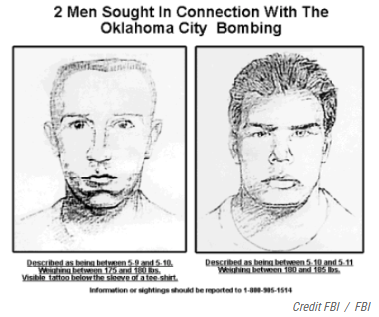
Employees at the shop helped the FBI quickly put together a composite drawing of the man who had rented the van. Agents showed the drawing around town, and local hotel employees supplied a name: Tim McVeigh.
He’d been pulled over about 80 miles north of Oklahoma City by an observant Oklahoma State Trooper who noticed a missing license plate on his yellow Mercury Marquis. McVeigh had a concealed weapon and was arrested. It was just 90 minutes after the bombing.
What did eyewitnesses report?#
The “Extra Leg”#
What is the Established Narrative?
What is the Established Narrative?
Were the only guilty parties really Timothy McVeigh, Terry Nichols, and Michael Fortier?
Why was an “extra leg” found?